Phil Brown
journalist . writer . poet
articles . books . poems
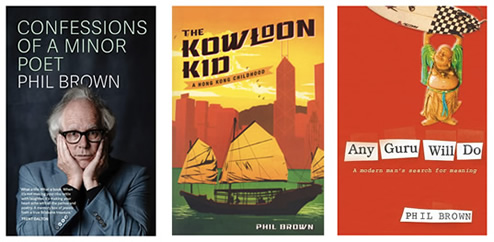
Confessions of a Minor Poet by Phil Brown
ISBN: 978-1-923023-41-3 - Rights: World - Format: Trade PB (234 x 153mm) 272pp - Non-Fiction
Transitlounge - $32.99 - Transit Lounge is an independent press dedicated to the publication of exciting new fiction and non-fiction
 TEXT review
No minor memoirist - review by Andrew Leggett
Phil Brown - Confessions of a Minor Poet
Brisbane journalist Phil Brown is making a splash in the field of memoir. His Confessions of a Minor Poet follows three previous such volumes: Travels with My Angst, Any Guru Will Do and The Kowloon Kid. He has also published two collections of poetry: Plastic Parables and An Accident in the Evening. - Read more
Brown graces us with the self-effacing humour of his literary adventures across the three eastern mainland states, from the 1970s to the present. He carries this with the apparent ease of a surfer riding a tube in the line-up off Fifth Avenue, Broadbeach, where he was a more frequent attender than at Miami State High. During his final year there, Brown's career as a poet began with the publication of a lyric drawn on the back of a surfboard.
Brown cites numerous influences, including a high school English teacher who encouraged his writing. When Brown decided, "in the absence of any real ambition," (p. 16) on a literary career, with journalism as entre via study at the Darling Downs Institute of Advanced Education in Toowoomba, he was encouraged by John McLaren, one time editor of Overland and founding editor of Australian Book Review, who advised him to attend Bruce Dawe's lectures.
Brown first encountered Bruce Dawe when the poet and educator gave a reading at Miami High School, but it was at the DDIAE that Dawe's influence on Brown's literary production became significant. "Literature with Bruce Dawe was a revelation" (p. 32). Brown confesses: "I was on a self-destructive bent that suited my poetic aspirations" (p. 39). "The whole experience of being at DDIAE was turning me into someone who might well qualify for admission to some place called The Institute" (p. 46). He acknowledges, with regret, "I had to relinquish my studies with Bruce because I just wasn't coping" (p. 47). After Brown left, with "half a Bachelor of Arts" (p. 47), the friendship with Dawe continued, a correspondence of mentorship that ended with Brown writing Dawe's 2020 obituary for The Courier Mail.
Through Bruce Dawe, Brown was introduced to Les Murray. He tells of taking the train from Murwillumbah to Chatsworth to visit the great poet. This journey inspired Brown's "Night Ride," the first of three poems that Les Murray published in Poetry Australia. Brown's gratitude to Murray for his patronage verges on veneration, but this does not prevent him from suggesting that Murray's recommendation that he announce himself, at a Poet's Union reading, as being sent by Les, was "a kind of black joke" (p. 88).
The self-deprecation continues with Brown's account of his failure as a timber cutter at Monto and his opportunistic appointment as a reporter for the local newspaper, The Burnett Herald, residing in a caravan "writing poems at night and reading Anna Karenina" (p. 98). Brown presents the formation of his acquaintance with greats of the art world as though they were happenstance, through friends like Gil Jamieson, in unlikely rural settings, as though he has fallen into his career as an aesthete by tripping over the Boree Log. Brown's narrative stumbles into Rockhampton, through the blues of a brief career as a television reporter and a stint as a casual in a bookshop and onto a job with The Morning Bulletin. "With my long hair and Lennonesque eyewear, plus being a poet"Brown tells us he was the obvious candidate to become the arts writer (p. 112). Connections made in that role included those with the Sydney Dance Company's Graham Murphy; actors such as Googie Withers, John McCallum, Leonard Teale; the poet and author Nancy Keesing; Manning Clark and his wife Dymphna; rock bands such as Australian Crawl and Split Enz; and even comedians Spike Milligan and Harry Secombe.
Brown resigned from The Morning Bulletin and returned to the Gold Coast following his father's death. He worked for the Gold Coast Bulletin, living back in the family home at Nerang as "the celebrity roundsman" of arts and entertainment (p. 128). After a relapse into drink and pills, Brown left work at the newspaper to stay on a health farm in Sydney. On return, he became "a freelance journalist and closet poet" on the Gold Coast in the 1980s "you could be a con man or a gigolo or a surf bum but not a poet" (p. 130). Brown recalls the Tamari Cafe at the top of Cavill Avenue, Surfers Paradise, as a bohemian refuge in the midst of his "emotional and spiritual bankruptcy" (p. 142). The glitter strip lacked what was necessary to sustain Brown's writing. When a socialite he knew opined that he would "never leave the Gold Coast," this pushed him to "break for Brisbane and leave Tinseltown behind," an epiphany he likens to that described in Thom Gunn's poem "On The Move" (p. 142).
Arriving in Brisbane, Brown found the job he'd been offered did not exist. He could not subsist on occasional "social reportage for the glamorous fashion magazine MODE" (p. 145), swanning around a Paddington Queenslander wearing a Chinese dressing gown, pretending to be "some Tang poet" (p. 144). Perhaps this is where Brown's career as a memoirist began, with the publication of an autobiographical piece on his childhood in Hong Kong, declaring himself an Orientalist. However in MODE, his struggles with "depression, alcohol and prescription drug dependency" (p. 145) were hidden, whereas they are frankly disclosed in Confessions. Brown was "a poet with a liquidity problem" (p. 150).
Brown was saved by a call from The Australian offering freelance work under Hugh Lunn's editorship in "Rupert Murdoch's precinct" (p. 151) in Fortitude Valley, while also contributing to The Daily Sun. Resignation of several other Sun journalists, following Brown's achievement of a front page scoop, gave him the breakthrough he needed to obtain permanent employment, financial stability and the opportunity to hang out at the Cosmo, frequented by underworld characters such as Gerry Bellino and Vic Conte, while reporting for MODE on the opening of Expo 88 and for the Murdoch papers on the downfall of the Bjelke-Petersen government. It was difficult to follow the trajectory of Brown's moves between roles with the Murdoch press and the Information Services at the Brisbane City Council, then back again to the Murdoch stable at Bowen Hills following its acquisition of The Courier Mail. Brown describes a brief and disastrous intervening stint as a social columnist for the Sunday Telegraph. He tells of the modest success of his poetry collection Plastic Parables in the midst of the squabbles that occurred in the goldfish bowl of Queensland Poets, an organisation that met for readings to minimal audiences in the cafe under Metro Arts in Edward Street, Brisbane.
In Confessions, Brown makes few references to relationships with women prior to his marriage. He also has little to say regarding the early burgeoning of the relationship with Sandra McLean, whom he introduces as friend and colleague, then wife and declared love of his life, a woman for whom he expresses his passion quietly while praising her support of his recovery from addictions, inspiration of his creative work and stabilising force in his journalistic work. Brown writes fondly of their time travelling in Nepal, working in Melbourne and returning to Brisbane together, where they have each continued their careers while raising a son.
Once the relationship with McLean is introduced, the tone of the work changes from its previous self- deprecation and despair to one of faith, hope and purpose.
I found myself disagreeing with criticism Brown told me he encountered at a reading where his work was featured at Books on Stones. "You should have stuck to journalism!" was the unkind comment offered.
Phil Brown's has been a quietly distinguished career as a journalist, and a modest one as a poet. As autobiographical writer, he excels, in the crucible that grinds this account of his struggle to generate meaning out of the banality of a journalistic life.
Andrew Leggett is a Queensland-based author and editor of fiction, poetry, interdisciplinary academic papers, reviews and songs. In addition to medical degrees and postgraduate qualifications in psychiatry and psychotherapy, Andrew holds a research master's degree in Creative Writing from the University of Queensland and a PhD in Creative Writing from Griffith University. His latest book is In Dreams and Other Stories (Ginninderra Press, 2026). He is an Associate Professor with the James Cook University College of Medicine and Dentistry.
TEXT Vol 30 No 1 April 2026 Managing Editors: Julienne van Loon & Ross Watkins Reviews Editors: Aidan Coleman & Verity Oswin

You may also like ...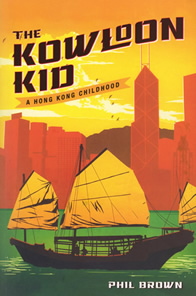
A Hong Kong Childhood
Transitlounge - 29.99
Reviews - Interviews
ANZ LitLovers LitBlog - Review
The Weekend Edition
THE LOCALS - An Interview
Brisbane News
The golden age
Cass Moriarty
What Am I Reading?
Blue Wolf Reviews - The Kowloon Kid: A Hong Kong Childhood
Any Guru Will Do
Phil Brown's life has been one long existential crisis.
His path to enlightenment has been uphill - think of climbing Everest with a colonic irrigation or two along the way.